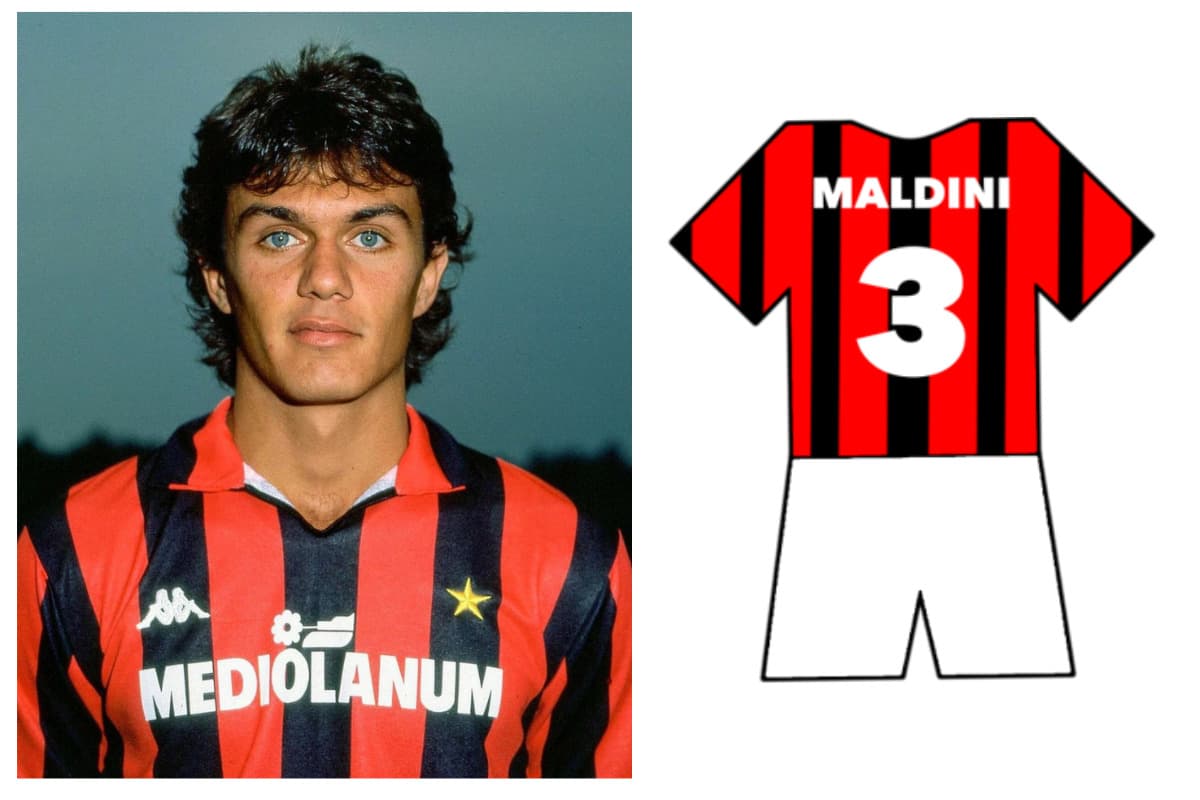
Welcome to the Appreciation Society
There are just some players that you can't dislike. Like Gianfranco Zola, Juninho, N'Golo Kanté or Pavel Nedved. Just really likeable players.
Add to that list Paolo Maldini, and welcome to the Paolo Maldini Appreciation Members Club.
We wanted to try to show off just how good of a player he really was.
We are assuming he was the kid at school that was good at everything. Everything he turned his hand to, he could excel. Tennis, cricket (is that a thing in Italy?), swimming, rugby. You name it, you bet he was able to just pick it up and be great at it. He strikes us as 'that guy.'
His looks and that lustrous hair! He could chuck on any old clobber and would look like a model in it. In fact, he was!
Oh, and it just so happens he was darn good at football. Yet still we can't not like him.
Big Shoes to Fill
Pretty handy he was good at football, as he had big shoes to fill. His father, Cesare Maldini, made 412 appearances for AC Milan as a defender and won four league titles with Milan. He became the team's captain in 1961, and went on to capture the club's first ever European Cup in 1963, as Milan defeated Benfica. Milan became the first Italian side ever to win the trophy, while Cesare became the first Italian captain to lift the cup. No pressure then, Paolo.
Debut, Dynasty, and the Number 3
It clearly didn't faze him, and in the 1984/85 season he made his first-team debut for AC Milan at the age of just 16 (and 6 months and 25 days). This made Maldini the youngest player to make an appearance for the club at the time. He was subbed on in a game against Udinese, replacing the injured Sergio Battistini. Battistini, at the time, was the youngest player to have played for AC Milan, having made his debut, also aged 16 (and 6 months and 28 days), in 1979. Maldini's record remained until 2023, when Francesco Camarda debuted for the Rossoneri at the tender age of 15 years old, also becoming the overall Serie A record holder.
Unbelievably, Maldini as a natural right-footer actually began his AC Milan career at right back. At the start of the 1985/86 season, Maldini became a regular at the San Siro, switching to the left full-back position and being handed the number 3 shirt, which had previously belonged to his father. Safe to say, he never looked back.
Then Came the Success
Under Arrigo Sacchi came Maldini's first trophy, the Serie A title in 1987/88 and the first of seven league titles with AC Milan.
The period of dominance that came in the following seasons coincided with the defensive unit of Maldini, Franco Baresi, Alessandro Costacurta and Mauro Tassotti.
The defensive giants then also began to dominate European football, with the attacking flair added by the Dutchmen Ruud Gullit and Marco van Basten. The Rossoneri won back-to-back European Cups in 1989 and 1990, with Maldini starting in both finals.
Capello, the Unbeaten Run, and Domestic Supremacy
With Sacchi moving on in 1991, the task was given to Fabio Capello to continue the dominance, and this proved no issue domestically. AC Milan and Maldini won the 1991/92 Serie A title, going the entire season unbeaten — a run that went on to become a remarkable 58-game league unbeaten streak! The 1991/92 league victory was the first of three consecutive titles under Capello for Maldini.
A European Cup final defeat in 1993 against Marseille was remedied a year later, beating Johan Cruyff's Barcelona — nicknamed the Dream Team — comprehensively 4-0. This reinforced the vision that Milan could in fact cope without Baresi and Costacurta, and instead rely on Maldini. The two defensive stalwarts were suspended for the European final, and this saw Maldini seamlessly slide into the middle of defence and thwart the threat of Romario and Hristo Stoichkov, a pair that had 55 goals combined for the season. In 56 games that season, up until the final, the Catalans had only failed to score on 9 occasions. Cue Maldini's intervention to make it 10.
Maldini added another — his fifth — league title in the 1995/96 season before Fabio Capello moved on.
International Duty and Near Misses
Having made his debut for the Italian national side in 1988, he featured in the 1988 European Championships, and on home soil in the 1990 World Cup. International success almost followed at the 1994 World Cup, losing out to Brazil in the final in the Los Angeles heat. Maldini, Baresi and co were the only team in the tournament to stop the Brazilians scoring en route to their victory.
It was Maldini, alongside Roberto Baggio, who made the team of the tournament for their exceptional performances throughout the sunshine in the United States. This was the second consecutive acknowledgement, having made the team of the tournament in 1990 also.
Captain of Milan, Captain of Italy
Following the retirement of Baresi in 1997, Maldini took the captaincy at the San Siro and lifted his first title in the role in the 1998/99 season, as champions of Italy once again. Maldini also took over the captaincy of the national team, again coming agonisingly close to a tournament victory, losing in another final — this time to France in the European Championship final of 2000. Scant consolation, but the gracious defender once again made the team of the tournament.
Back in Milan and under the new management of Carlo Ancelotti, and with a new defensive partner in Alessandro Nesta, Maldini won his fourth Champions League trophy, defeating Juventus in 2003 and being named as the Man of the Match. A further Serie A victory followed in the 2003/04 season — his 7th and final — winning the league championship some 16 years after his first.
The Last Finals and a Record-Breaking Legacy
Maldini went on to captain Milan in two further Champions League finals. First in 2005, in which he scored — becoming the oldest player to score in a final, aged 36 — but ultimately ending on the losing side. Then in 2007, Maldini became the oldest captain, at 38, to lift the trophy, as Milan took revenge on Liverpool, winning 2-1.
His 8th appearance in the European/Champions League final is a joint record. At the time of his retirement, Maldini could lay claim to having played the most minutes in the Champions League competition — 11,932 to be precise. Even having retired almost 20 years ago, to date, he remains in the top ten.
A Career Measured in Records
The 2008/09 Serie A season was to be the last as a professional for Maldini. In a career that spanned 25 years, the classy defender racked up 902 first-team appearances for AC Milan. Unsurprisingly, this is a club record. Remarkably, in his final season, aged 41, he mustered 30 league appearances — a number he only bettered 5 times in the previous 24 seasons. His longevity is further proven by the remarkable statistic of being the player to have played the record number of minutes at World Cups combined. 2,217, if you were wondering. He won a total of 126 caps for the Italian national team, captaining the Azzurri for 75 of those appearances. Both were records at the time, until surpassed by Fabio Cannavaro.
La Dolce Vita
He was relentlessly consistent. He never looked flustered, retaining those model looks throughout. The glorious defender, Maldini is in fact the archetypal Italian — rich heritage, artistic, fashionable, and a gladiator-like performer, with the Colosseum replaced with the San Siro for his stage. Although nicknamed throughout his career as Il Capitano, we could argue he is more of a concept — la dolce vita — the sweet life, celebrating all that is good with the Italian lifestyle.
The mathematicians amongst us can quickly calculate that Maldini played in over 1,000 professional appearances — not a club membership open to many.
The Sacred Number 3 and Son Daniel
As with Baresi's number 6 shirt, AC Milan announced the retirement of Maldini's number 3 shirt. No player has worn the number for the Rossoneri since. Maldini stated he would be happy for it to be reintroduced if either of his sons made the AC Milan first team. In 2020, aged 18, his son Daniel did just that. However, the youthful Maldini was more attack-minded than his grandad and dad, instead taking on a more forward role. Squad numbers 98 and 27 were taken during his time at the club, but eventually he moved on having played just 24 times for the club. For context, Paolo won 23 major trophies during his 25-year tenure at the club.
Was There Nothing He Could Not Do?
As we described at the beginning of the article, it seems Paolo Maldini is 'that' guy. Turns out he is…
In June 2017, post his retirement from football, Maldini qualified for the Aspria Tennis Cup in Milan, a professional tennis tournament on the ATP Challenger Tour, along with his doubles partner Stefano Landonio, after winning a qualifier in Italy. Was there nothing he could not do?
The only real surprise is that the perennial winner didn't bring home that trophy as well.
Simply put, Maldini learned from the best to become the best. La dolce vita — the only modern-day footballer seemingly able to slow down to enjoy the moment, almost in a relaxed state whilst mastering the art of defending. It's said you can't carry 'luxury' players, yet the most luxurious of them all got to the top and stayed there by being just that.
Explore more
You can browse the full list of shirt numbers on the site to see which players wore each number across different clubs and eras.